Your Daughter's First Bra: A Parent's Guide to Sizing, Styles and UK Fitting Services (2026)
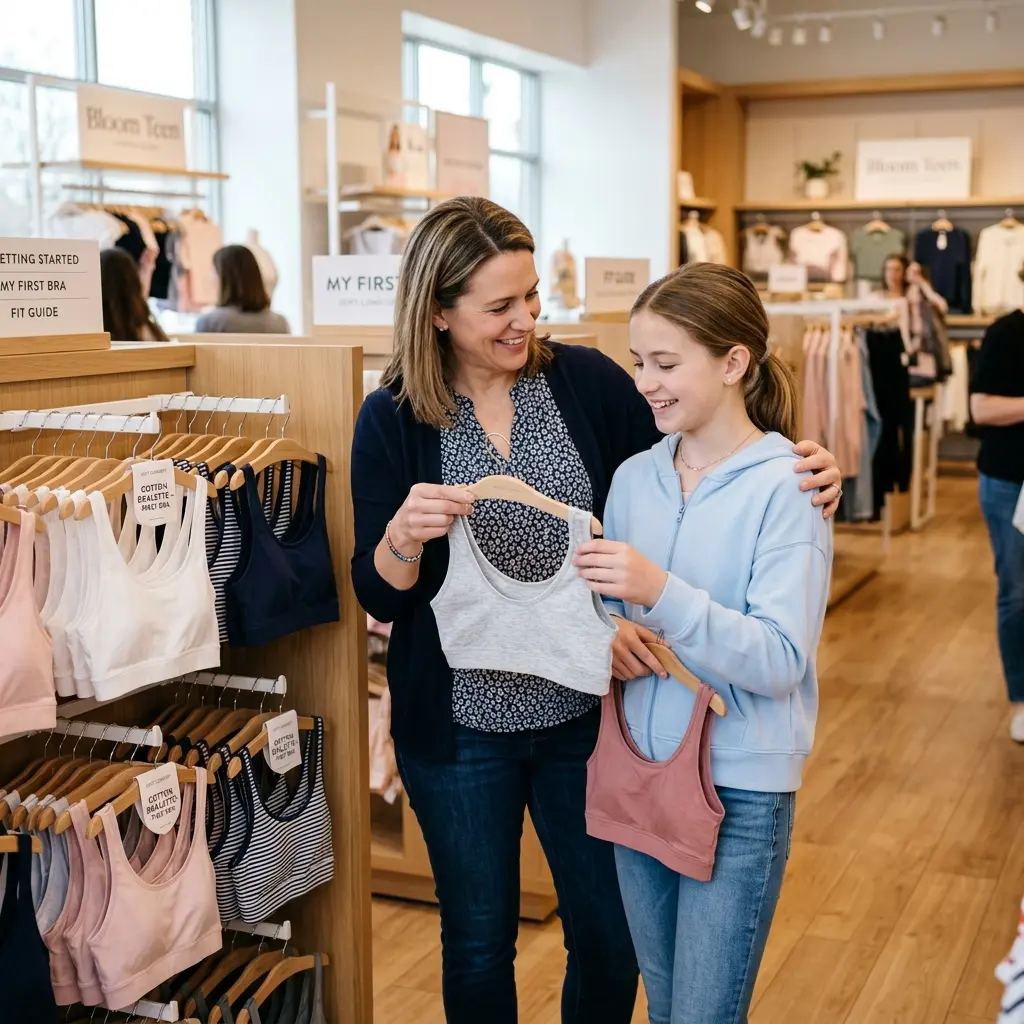
When does a girl need her first bra?
There's no magic birthday. The average age in the UK sits around eleven, but puberty starts earlier for some girls — breast buds can appear at eight — and later for others, and both ends of that range are completely normal. It's often hereditary too, so your own timeline is a rough clue.
The practical signs are easy to spot once you know them. She mentions discomfort or movement during PE or sports. Her chest looks or feels tender. Nipples show through school shirts. She's suddenly secretive about getting changed, or she's asking because her friends already wear one.
That last one matters more than parents think. If she wants a bra to fit in with her peers before she strictly needs the support, buy her one anyway. A £6 crop top costs you nothing and spares her the changing-room teasing; refusing “because you don't need it yet” is the line women still quote back at their mums twenty years later. For a tween or young teenager, feeling ordinary is the whole point of this milestone.
Starting the conversation without the cringe
Handle this sensitively, because it's a moment she'll remember. Girls at this stage are wrestling with insecurities and self-conscious feelings about a changing body, and what they need most from a parent is reassurance that whatever's happening — uneven growth, soreness, one side ahead of the other — is standard-issue development.
Let her lead where you can. A gentle opener works better than an announcement: mention it while shopping for something else, or share when you got yours. If you're a dad, a single mum of boys, or simply not the person she'll talk to, rope in another trusted adult — an aunt, a gran, a family friend. The goal is to normalise the whole subject the way we treat shoe fittings: routine, unremarkable, nothing to whisper about.
I'd also teach her the basics early: how a bra fastens, how straps adjust, and that sizes say nothing about body image or maturity. Fitters at good independent shops build this education into the appointment, including age-appropriate anatomy chat and the habit of self-checks, and it pays off for decades. A girl who understands her own fit at twelve doesn't spend her twenties in the wrong size.
How to measure for a first bra at home
If a shop visit feels like too much (very common — more on that below), you can size her at home with a soft tape measure in two minutes.
First, the band size: measure around the ribcage, directly under the bust, keeping the tape level and snug — you should just fit a finger underneath. That number in inches, rounded to the nearest even number, is her band. Ignore the old advice to add plus four; it dates from rigid 1950s fabrics and produces bands that ride up and give no support. Modern UK fitters, and the widely recommended Boob or Bust method, size the band at the actual underbust measurement.
Second, the cup size: measure loosely around the fullest part of the bust, then subtract the band number. Each inch of difference is one cup — under an inch is AA, one inch is A, two is B, and so on. So a 28-inch underbust and 30-inch bust means a 28AA–28A. Most retailer websites have a calculator that does the maths for you.
Two caveats from experience. Brands cut differently, so treat the number as a starting point, not gospel — always judge the fit on the body. And learn her sister sizes (go up a band, down a cup, or vice versa), because teen ranges are limited and a 30A shopper will sometimes only find a 32AA on the shelf.
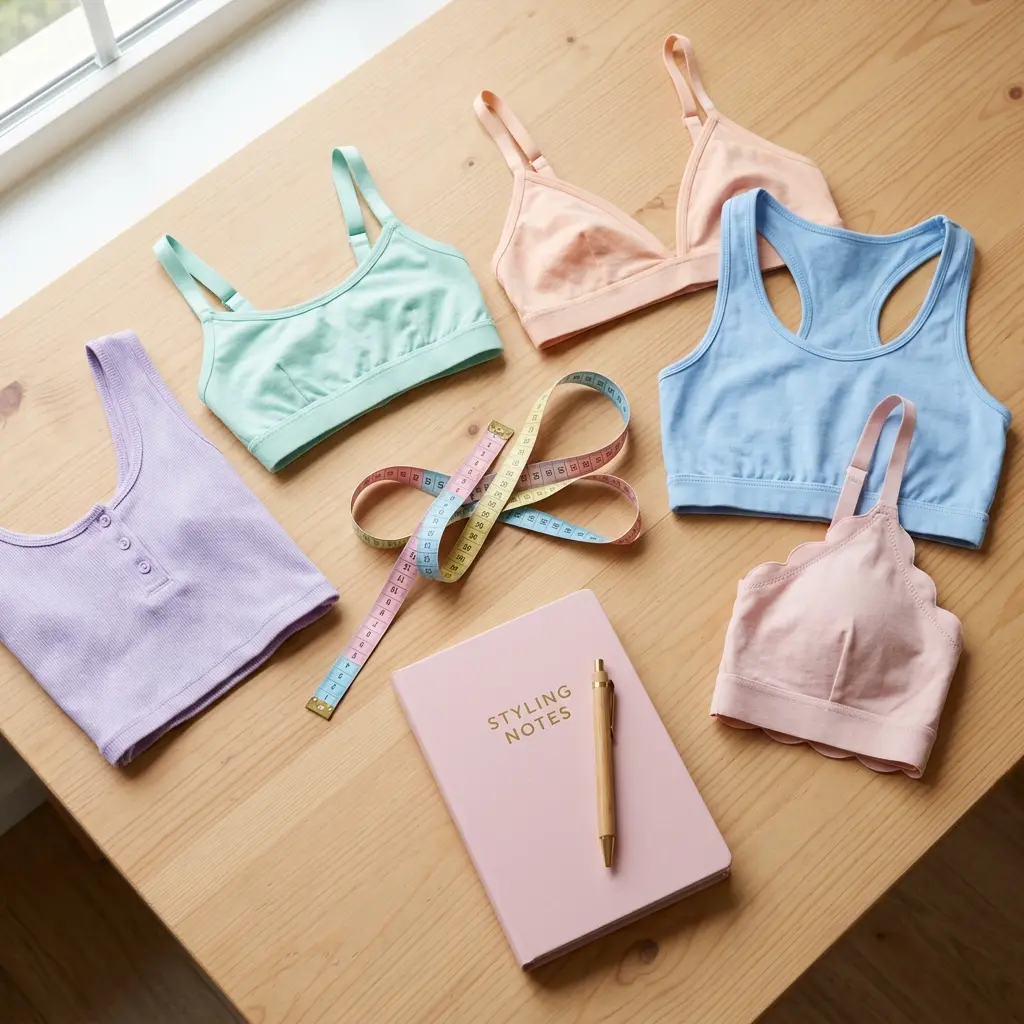
First bra styles: crop tops, bralettes and non-wired bras
For the very start of development, a crop top is honestly all she needs. They're soft cup, unlined, usually sold in cheap multipacks, and they solve the two problems that actually bother girls at this stage: modesty under thin shirts and rubbing on sensitive skin. Look for cotton or microfibre, seam-free finishes and tag-free labels — itch is the number-one reason first bras end up in a drawer.
Once there's genuine breast tissue, move to a proper starter bra — what older guides call a training bra. The good ones are non-wired with adjustable straps, a hook-and-eye back, and light double-layer coverage. A bralette does the same job with a prettier look for teens who care about that. Non-padded versions give the most natural feel; lightly padded styles aren't about size, they're about nipple coverage, and plenty of girls prefer them under school shirts for exactly that reason.
Two practical buys round out the drawer. A skin-tone or nude bra disappears under white school blouses far better than white does — the counterintuitive tip every fitter gives. And if she does any sport at all, a proper sports bra (a racerback stays put nicely) is non-negotiable, because developing tissue shouldn't be bouncing through netball. Save the fun prints, the t-shirt bra and the front closure styles for when she's choosing for herself — which happens fast.
Why underwired bras can wait
Every UK fitter, from M&S to the smallest boutique, gives the same advice: no underwired bras while the bust is still developing. A rigid wire pressed against delicate, growing breast tissue is uncomfortable at best, and a poorly fitted one can dig in and restrict the natural shape of growth.
The support argument doesn't hold up either. At first-bra sizes there simply isn't the weight that wires exist to manage — a well-fitted soft band does the job, protects the Cooper's ligaments that hold breast shape long-term, and causes no damage or dents along the way. Wires can come later, in the late teens, once growth has settled. There's no rush; most women I know wish they'd stayed out of them longer.
UK fitting services compared: M&S, John Lewis, Bravissimo and independents
This is the bit no other guide lays out plainly, so here it is. Marks & Spencer runs a dedicated first-bra appointment: free, thirty minutes, bookable online, and — the detail that reassures nervous girls most — her top stays on throughout. The teen range is decent and cheap, and for most families it's the sensible first stop. The measuring quality varies by store and fitter, so trust your own fit checks over the number on the ticket.
John Lewis also offers a free service with first-bra slots bookable online, and parents consistently describe the fitters as discreet — they'll advise, help with clasps, and step out of the room before any undressing. Appointments are shorter than M&S (around fifteen minutes at some branches), but the department store setting means you can browse the wider lingerie floor after. Bravissimo deserves its brilliant reputation — fitters size by eye, no tape measure — but it's built for D-cups upward, so it's rarely right for a first bra; file it away for later years.
The dark-horse option is a local independent boutique. Shops like Janice Rose Lingerie or London's Amelie's Follies work by appointment only, which means privacy, no queue, and a fitter who'll teach her how to put a bra on, wash it and check her own fit — genuine education, not just a sale. Prices run higher (first bras from roughly £26 versus a fiver on the high street), and Rigby & Peller sits at the luxury end if budget's no object. If your daughter is anxious, autistic, or just private, the quiet unhurried independent appointment is worth every penny — and if she refuses any shop at all, measure at home and order online. No fitting is worth a meltdown.
How many bras to buy and what to spend
Start with two or three, minimum. One on, one in the washing, one drying — a single bra worn daily goes grey and baggy within a term. Add a sports bra on top of that count, not instead of it.
On budget: a multipack of crop tops from Matalan, Asda or Sainsbury's costs £6–£12 and is perfect for the earliest stage. M&S first bras run about £8–£16 each and hold up well to a school week. An independent boutique bra at £26+ buys noticeably better fabric and fit. My honest advice is to spend little and often rather than big and rarely — she'll outgrow whatever you buy within months, so quality matters less than rotation and the right size today.
Checking the fit and knowing when to re-measure
A quick weekly glance tells you everything. The band should sit horizontal all the way round — if it's riding up at the back, it's too big. You should fit one finger under it, no more. Straps shouldn't be digging in (loosen them, or the band's doing too little work) and cups should lie flat against her: gaping fabric means too big, spillage or side-cutting means too small. If a size is half-right, adjust with a sister size before giving up on a style, and start on the loosest hooks so there's tightening room as the elastic relaxes. For complete steps, see our how to measure bra size guide.
Then re-measure relentlessly. Girls this age can jump a size in a single growth spurt — practically overnight — so check every few months, or every four weeks if she's growing fast, and immediately whenever she says a bra's stopped feeling comfortable. A bra that fit at Christmas can be genuinely wrong by Easter. The habit of noticing is the real gift here; hand it to her early and she'll carry it for life.
Frequently Asked Questions
Whenever her body — or her confidence — needs it. The UK average is about 11, but anywhere from 8 to 14 is normal. If she asks for one, that's reason enough.
Need to check your measurements right now?
Use our free online UK Bra Size Calculator to calculate accurate band and cup sizes in seconds using cm or inches.
Calculate Bra Size Free